

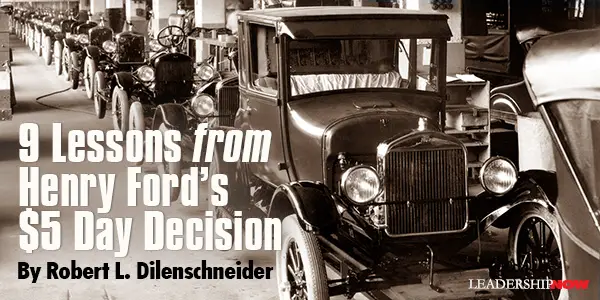
9 Lessons from Henry Ford’s$ 5 Day Decision
Any choice you make isn’t worth a tinker’s damn till you have actually formed the routine of making it and keeping it.
IMAGINE that this is your circumstance: Your young company is a raging success. Its product, a basic one that can be produced quickly since of a manufacturing process that you created, iswildly popular. Then picture that this is your problem:
You have to replace your employees 3 or 4 times a year. Your great manufacturing process is driving your workers away. They can’t tolerate it!
What would you do?
Anyone who runs a company knows that a high employee turnover rate is … well, bad. The capability to attract and keep staff members is crucial to durability and success. For how long can a business make it through if its entire labor force turns over three or four times a year?
As somebody who has actually run his own business for over twenty-five years, I have numerous thoughts on this question. If my organisation had such a high worker turnover rate, do you think it would strike me to double my employees’ earnings?
That’s what this specific entrepreneur did. His name is Henry Ford, and all of us know what the Ford Motor Business is. Perhaps you bought one of the 2.5 million cars that Ford offered in the United States in 2015.
Let me set the scene, and then discuss the choice Ford made to conserve his business– a service decision that Fortune magazine said is the “greatest” of all time.
Henry Ford established his company in 1903 to produce cars for the “common male.” The vehicle itself had already been created– the expression “success has lots of dads, but failure is an orphan” comes to mind, as there are several “dads” of the first automobile (in truth, it was most likely the German Karl Benz in 1885 or so).
In 1903, autos were an elite item. Only the rich could manage them. They were hand-built, typically to individual specifications. They were also really heavy, as they had to withstand the rigors of mainly unpaved roadways used by the horse-and-wagon mode of transportation.
His was not the only automobile business, Henry Ford had some essential early insights. He simplified the design and building of the car, narrowed the options readily available (” any color you want, so long as it’s black”) and marketed it towards what we would today call the “down market.” And as the American road system enhanced because more people were driving automobiles, the vehicles themselves might become lighter, a truth that Ford benefited from.
In 1913, Ford took a big leap forward. He abandoned the conventional hand-building procedure that included each employee performing a variety of different jobs to put a cars and truck together. That mishandled! Specifically when need for Ford’s items was ballooning– workers might not work quickly enough.
Rather of having the car-in-process remain in one put on the factory flooring, with workers walking to different places to get what they needed and then strolling back to the vehicle, Ford instituted the “assembly line.” The car-in-process would be dragged or pushed or otherwise communicated along a line. Employees would remain in one place, performing one job. Upon completion, the cars and truck would move along to the next group of employees, who would carry out another job.
Revolutionary! More efficient! And, initially, simpler on the employees. Workers began to lose the sense that an entire cars and truck was emerging under their hands. Doing the exact same job over and over was not as pleasing. And as assembly-line innovation improved, so too did its speed, which quickly became a source of excellent tension. The employees might barely keep up. And thus was born the issue of high employee turnover. Almost as quickly as they discovered what to do on the job, workers decided that they did not desire the job.
Only a year after Ford’s innovative innovation, it was obvious that the assembly line had a huge unpredicted downside. Ford’s company remained in a precarious position. The cost of finding and re-training workers was ending up being debilitating. The effectiveness that was the guarantee of the assembly line could not be sustained. Both earnings and earnings were beginning to decrease.
It’s intriguing to me that Ford’s solution was not to alter the nature of the assembly line. As I noted at the very beginning of this chapter, Henry Ford both made and kept to his choices. We have seen this trait in other crucial decision-makers. Ford thought in his invention.
His invention depended on human beings, not robotics (keep in mind, this was 1914). If Ford’s workers were not growing, then he would have to alter the conditions under which they worked. Make the conditions more appealing. Raising pay was the obvious first action.
” The $5 Day” came at a time when most assembly line workers were making about $2.50 a day. This wage-doubling was not approximate. Ford and his consultants determined that anything less would not be a reliable incentive, and anything more would begin to depress revenues. An extra $2.50 was the sweet spot. An associated effort was the three-shift per-day schedule (rather than 2), which opened more real tasks.
The “$ 5 Day” not only fixed Ford’s instant problem. Stealthily simple, his choice likewise sowed the seeds of the culture of consumerism that pervades, even defines, our lives today. For good or ill. That’s why Fortune‘s editors called it as the supreme in their 2012 book The Greatest Business Decisions of Perpetuity. Making $5 a day, Ford’s employees could finally manage to buy that Design T they were making.
Henry Ford was nothing if not a visionary, iconoclastic, and decisive businessman. Even early in his profession, he possessed those qualities, and his credibility only grew throughout his life time. Today, seventy-two years after the founder’s retirement and seventy years after his death, Ford is among the terrific business of our time. Do you think Henry Ford, as astute as he was, had any inkling what his 1914 choice to double his employees’ wages– in today’s parlance, to pay his workers a living wage– would imply?
9 Lessons Here are the leading lessons I take from Henry Ford’s $5 Day decision that can apply to us:
- Your staff members require to be rewarded and feel rewarded. They need the tangibility of appropriate settlement and the intangibility of satisfaction. All individuals need to be valued.
- Life and service are both constantly moving. You need to monitor and be prepared to change.
- No matter how important you or your organization is, you need to reveal empathy and to listen to and coach those around you.
- Results of decisions are in some cases better appreciated in hindsight. Sometimes impacts are what has been wished for, however sometimes there are “unintended consequences.”
- You do not have to be a corporate CEO to take advantage of Ford’s example. He carefully studied the issues inherent in the automobile-manufacturing process along with the implications of different methods to attend to the problems. Then, he made his decisions and quickly executed them.
- No in on your biggest problem. Concentrate on the real barriers before you, not the interruptions.
- Honor custom however do not be hidebound to it.
- Understand the significance of people and the impact of your decision on them. Act appropriately.
- Constantly think about the outcome or benefit of your choice so that you can use that decision to motivate yourself and others.

Robert L. Dilenschneider has actually worked with more than 3,000 successful specialists, and advised thousands more. He is creator of The Dilenschneider Group, a corporate tactical therapy and public relations firm based in New york city City. Formerly president and CEO of Hill & & Knowlton, he is the author of the successful books Power and Influence, A Briefing for Leaders, On Power and freshly launched. For more details, please visit RobertLDilenschneider.com
This content was originally published here.